
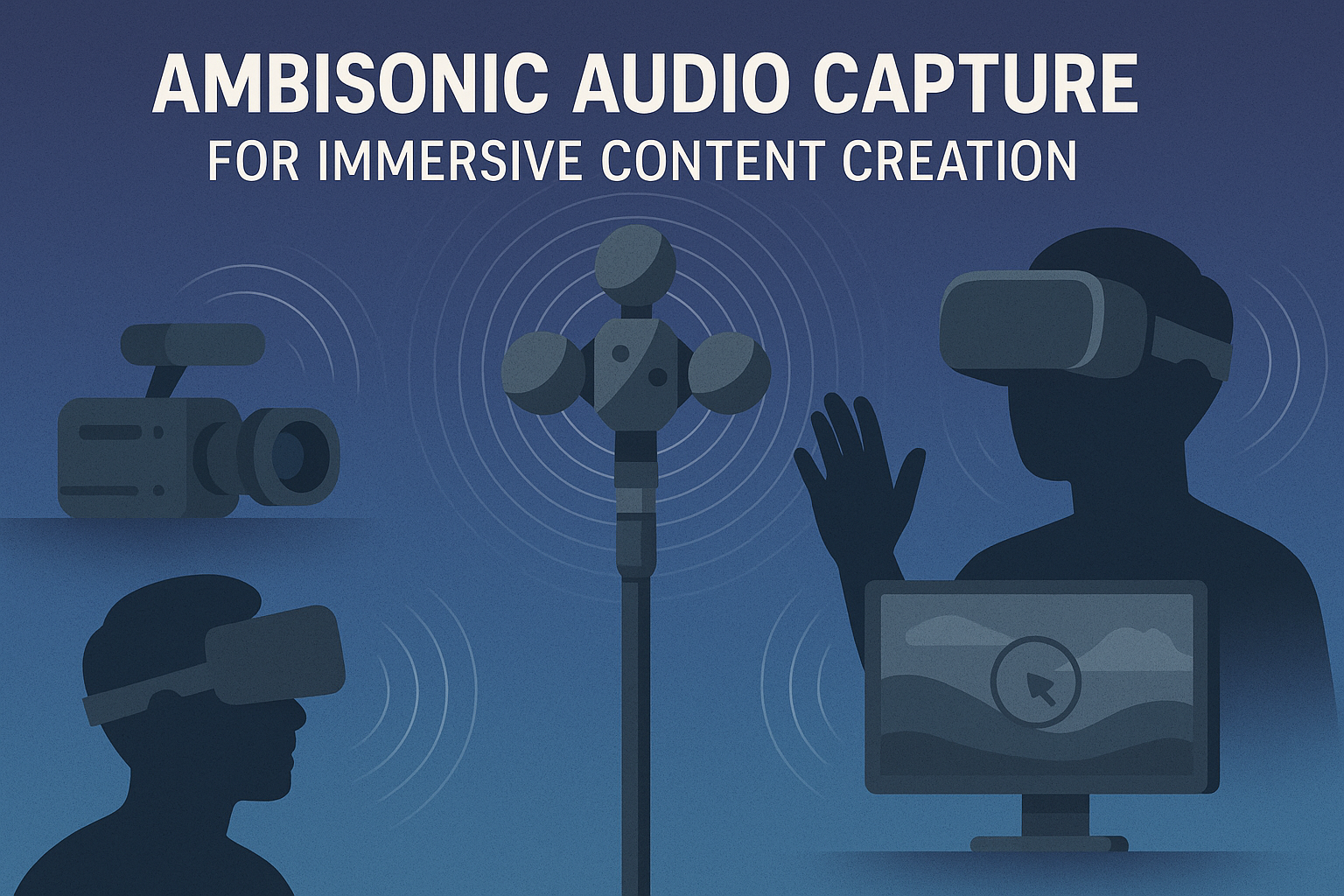
The Power of Ambisonic Audio in Immersive 180° Film-making.
When creating immersive video (especially 180° content) visuals often take centre stage. Yet in reality, sound is at least half the experience. If done well, it creates a whole that is more than the sum of the parts. Ambisonic audio is what gives immersive media its
sense of presence, letting audiences feel where they are within a scene.
What Is Ambisonics?
Ambisonics is a full-sphere recording and playback system that captures
sound from all directions – front, back, above, and below. It does not route signals to specific speakers. Instead, it encodes the entire sound field mathematically. This allows playback systems to decode it for any setup:
stereo, surround, or head-tracked headphones.
Ambisonics was developed in the nineteen seventies by British researchers Michael Gerzon and Peter Fellgett. It was far ahead of its time. Like many technologies, it sat in the corner waiting for its moment. Modern moves towards Virtual and augmented reality have advanced the immersive soundscape. Immersive video entertainment has also contributed significantly. With spatial computing devices like Apple Vision Pro, users can synchronise visual, audio and real world elements. This ability allows Ambisonics’ true potential to be realised.
How Ambisonics Works
Ambisonics uses a tetrahedral microphone array (four capsules arranged
in 3D space) to capture sound. The raw signals (called A-format)
are converted into B-format, consisting of four channels:
- W – Omnidirectional sound (overall pressure)
- X – Front-back information
- Y – Left-right information
- Z – Up-down information
B-format audio can be encoded in 2 flavours: Ambix or FuMa. Both have their trade offs but to date, the immersive film industry leans toward Ambix.
Together, these form a full spherical representation of the sound
environment. Unlike traditional surround formats, Ambisonics is not limited by speaker type. The same recording can be decoded for any number of speakers or binaural playback.
speaker-agnostic (the same recording can be decoded for any number of
speakers or binaural playback).
Higher-order Ambisonics (HOA) adds even more channels (9, 16, or up to
49) greatly improving directional and spatial precision.
As part of the Apple Immersive Video specification, this enhancement uses Apple Spatial Audio Format (ASAF). This format can layer extra object points atop the audio field. It allows for total audio control.
Why It Matters for Immersive 180° Video
In 180° film-making, your camera sees a hemisphere, but your audience
hears a sphere. Sounds outside the viewer’s visual field (like
footsteps behind the camera or birds above) enhance realism and
tension. Furthermore, the background room noise gives a sense of scale or intimacy. This effect is comparable to using a reverb plugin. The plugin emulates the size of a room where a recording was made.
Ambisonic audio delivers several major advantages over traditional surround
systems:
- Head Tracking – The audio stage reacts to the viewer’s head movement. it rotates with the viewer’s head to keep the precise spatial position of content compared to the visuals.
- Continuous Sound-field – Unlike 5.1 or 7.1 surround, Ambisonics
doesn’t “jump” between speakers; it creates a smooth, continuous
sphere of sound. - Universal Compatibility – YouTube, Facebook, and Apple Vision Pro natively support Ambisonic B-format audio.
- Creative flexibility – in post production point lines you can Steer or rotate the virtual microphones position. It allows reshaping the sound field in relation to the viewer. This allows adjusting the perspective and directional cues even after recording.
This flexibility makes Ambisonics an ideal tool for creators. It helps anchor their viewers using emotional presence in their storytelling.
Where It’s Used
- Immersive Films – Build believable soundscapes that react to viewer movement.
- VR Gaming – Like the Immersive film experience, Ambisonic audio adds layers to open world gaming.
- Music and Performance Capture – Record concerts or ambient spaces with true spatial depth.
- Broadcast and Sports – Capture stadium or environmental ambiance with a single mic array.
The TLDR
Ambisonic recording isn’t just a technical improvement – it’s a creative evolution. Even in the loudest environments, it bridges what the eye sees with what the body feels. Many would assume that background noise would be lost in the mix, but it transforms passive viewing into true immersion.
“Sound is 50 percent of the movie going experience, and I’ve always believed audiences are moved and excited by what they hear in my movies at least as much as by what they see.” George Lucas